
Blog

This is the Iceventure blog - offering the best of reality in form of articles

Dott. Arnbjörn Eggerz
22. Mai 2026
geschrieben von
Freigegeben in newsletter

N03 – Comprendere gli investimenti capex dell’AI: analogie tra ferrovie e dot-com

Banner newsletter Iceventure: Comprendere gli investimenti capex dell’AI: analogie tra ferrovie e dot-com

Le notizie delle ultime settimane stanno facendo il lavoro di un intero calendario editoriale. Anthropic è nella fase finale di un round da cinquanta miliardi di dollari a una valutazione riportata di novecento miliardi di dollari, e le persone di cui mi fido nelle cap table mi dicono che il numero finale sarà più probabilmente sopra che sotto tale cifra. OpenAI si attesta a ottocentocinquantadue miliardi post-money dopo aver chiuso a marzo un round da centoventidue miliardi di dollari. SpaceX, con xAI ora integrata, sta preparando un roadshow per una IPO a una valutazione riportata di un trilione e tre quarti. Tre aziende il cui fundraising combinato nel 2026 potrebbe superare l’intero mercato IPO statunitense del 2025 per un fattore cinque.

È il momento giusto per condividere e riprendere la domanda su cui io e il mio team stiamo lavorando con family office e contatti aziendali da circa sei mesi: quale analogia storica si adatta davvero a questo ciclo tecnologico, e quanto costa all'investitore che agisce di conseguenza scegliere l'analogia sbagliata.

Questa edizione si concentra principalmente su un tema — l’anatomia strutturale del ciclo dell’AI vista attraverso i boom storici — e utilizza quanto emerge per dire qualcosa di concreto su come i clienti dovrebbero pensare oggi all’implementazione dell’AI. Come sempre, fornisco anche un punto di vista sull’impatto europeo di questa tendenza globale.

Read in English

Dott. Arnbjörn Eggerz
20. Mai 2026
geschrieben von
Freigegeben in newsletter

N03 - Making sense of AI’s capex investments: analogies between railroad and dot.com

Newsletter Banner n03

Past weeks’ news is doing the work of an entire editorial calendar. Anthropic is in the final stage of a fifty-billion-dollar round at a reported nine-hundred-billion-dollar valuation, and the people I trust on the cap tables tell me the final number is more likely above than below that. OpenAI sits at eight hundred and fifty-two billion post-money after closing a hundred-and-twenty-two-billion-dollar round in March. SpaceX, with xAI now folded in, is preparing a roadshow for an IPO at a reported one and three-quarter trillion. Three companies whose combined 2026 fundraising could exceed the entire US IPO market of 2025 by a factor of five.

This is the moment to share and revisit the question my team and I have been working through with family offices and corporate contacts for about the last six months — what historical analogy actually fits this tech cycle, and what does the wrong analogy cost an investor who acts on it.

This edition stays mostly on one topic — the structural anatomy of the AI cycle seen through historical booms — and uses what comes out of that to say something concrete about how clients should be thinking about AI implementation today. As always, I also provide a European impact of this global trend.

Leggi in italiano

geschrieben von
Freigegeben in Digitalisierung

Software selection gestionale ERP: come strutturarla, errori e importanza del capitolato tecnico


Uomo che analizza un capitolato tecnico ERP su laptop - software selection gestionale per PMI

La scelta di un software gestionale ERP (Enterprise Resource Planning) è una delle decisioni strategiche più importanti per un'azienda. Si tratta di un progetto di trasformazione aziendale, non solo un progetto IT: coinvolge persone, processi e organizzazione a tutti i livelli, e che condizionerà il modo di lavorare dell'azienda per i prossimi 7-10 anni.

Nonostante questo, molte aziende saltano la fase di analisi interna e guardano al possibile software senza aver prima definito cosa serve davvero in specifiche tecniche, funzionali e progettuali chiare e condivise. Senza dei requisiti chiari, i fornitori faticano a comprendere il contesto reale e a formulare proposte pertinenti, mentre l'azienda si trova in difficoltà nel valutare le varie soluzioni e partner di implementazione. In un mercato che offre centinaia di soluzioni, da ERP generalisti a gestionali verticali specializzati, il risultato è una decisione presa su basi fragili, con tutti i rischi che ne conseguono.

Un capitolato tecnico dei requisiti software serve ad allineare azienda, consulenti, fornitori e partner su cosa il nuovo ERP deve saper fare, con quali priorità e in quali vincoli tecnici e organizzativi. In oltre 15 anni di lavoro con aziende europee di diverse dimensioni e settori, abbiamo osservato gli stessi errori ripetersi nella scelta di software gestionali e di produttività, e abbiamo sviluppato un approccio strutturato per evitarli. In questo articolo condividiamo entrambe le cose: i pattern più comuni nelle software selection e ciò che, nella nostra esperienza, rende un progetto ERP di successo, con il capitolato tecnico come strumento centrale.

04. August 2025
geschrieben von
Freigegeben in Start up

Scaling a Startup: What to Expect When Growth Gets Real

Illustration of people working on an airplane mid-flight, assembling it while flying — a metaphor for scaling a business while still building core systems and processes.

Scaling a company is never as straightforward as the books or podcasts make it sound. Most founders know the theory, they studied business, read startup blogs, maybe even worked in high-growth companies before. But nothing truly prepares you for when you're the one sailing the boat. And even for experienced founders, the biggest constraint is often time. Time is always short, demands multiply fast: suddenly, you’re hiring 10 people within weeks, building processes on the fly, and realizing that what worked for five people breaks at 15, then again at 50 until the next inflection point.

Even with strong traction, the scale-up phase brings unfamiliar challenges. How do you grow your team without losing your early culture? How do you build internal structures without losing agility? How do you manage cashflow during rapid growth, where costs often rise faster than revenue?

These are not abstract concepts anymore. They are urgent, operational decisions with consequences.

VCs and advisors can offer valuable input, but when it comes to the day-to-day reality of scaling, it is rarely enough on its own. More often than not, founders find themselves navigating these challenges with limited support, learning by doing, under real pressure.

Scaling for the first time? It feels a lot like building a plane while flying it. And it can feel...lonely. 

In this article, I will unpack the most common pitfalls founders face when scaling, with a special focus on the unique realities of scaling in Germany. I will also share practical tips and concrete steps to help you scale your business more sustainably.

18. Juni 2025
Freigegeben in Start up

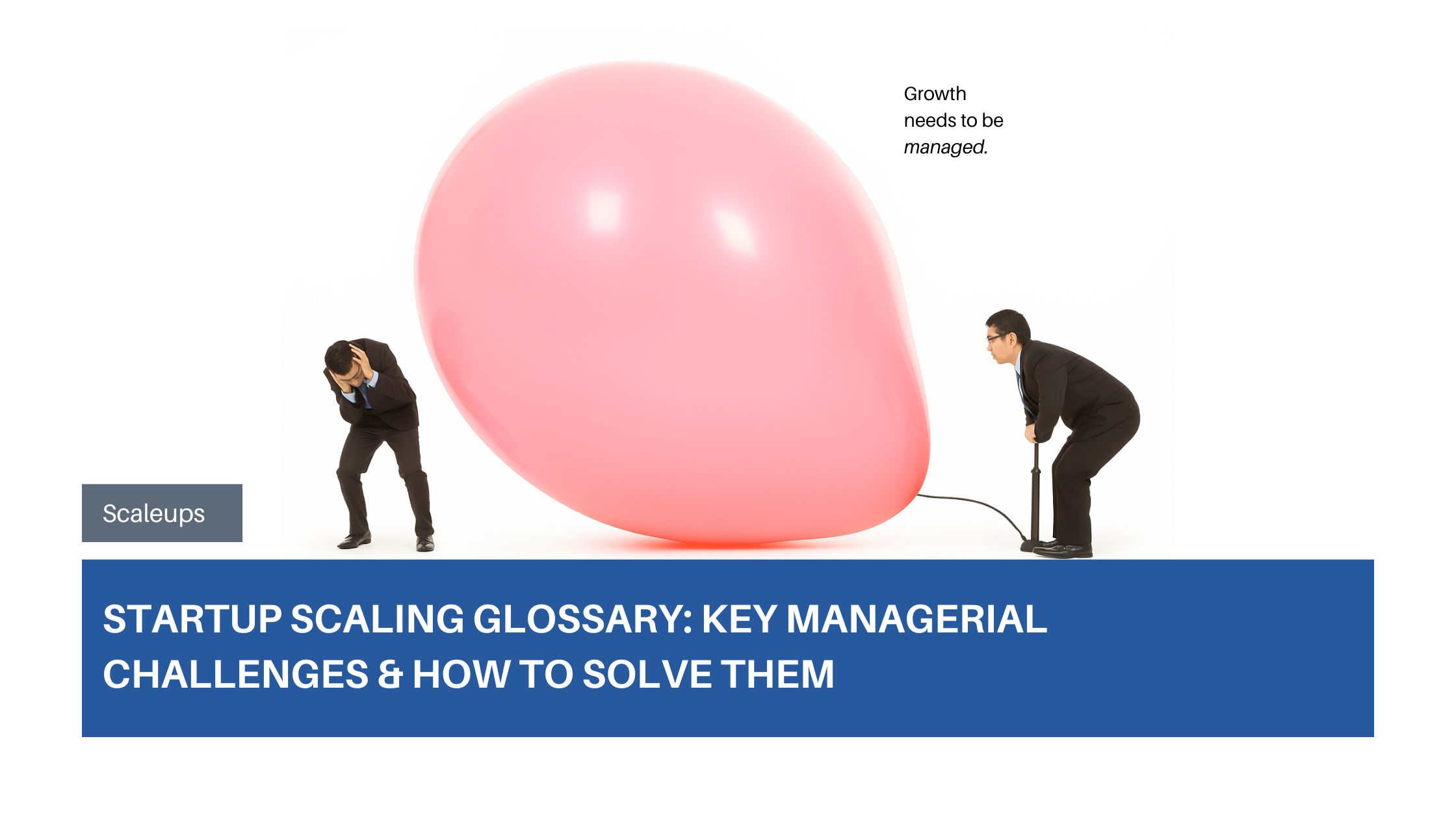
Startup Scaling Glossary: Key Managerial Challenges & How to Solve Them

Banner Blog Post Iceventure: Managerial Challenges of Scaleups and Rapid Growth - A-Z Glossary

Scaling a startup is like raising a baby: exciting, rewarding, but then things could go sideways if you're not careful. It comes with a unique set of managerial challenges that can make or break success. According to the ESI Scaleup Monitor 2025, only 0.47% of European firms are categorized as scale-ups (younger companies achieving consistent hypergrowth of over 40% annually) highlighting just how challenging and demanding sustainable hypergrowth is.

Once you’ve nailed product–market fit, the next challenge kicks in: scaling rapidly, being prepared for it, and managing growth without losing focus or control. Most don’t succeed. What worked with a team of 10 starts to crumble at 30. Then again at 100. The Startup Genome Report shows that 74% of high-growth startups fail: not because of a bad idea, but because they scaled too early or managed it poorly.

Whether you're chasing Series B or building a sustainable B2B engine, scaling exposes hidden weaknesses: in leadership, revenue models, cost structures, internal systems, and organizational design. And often, you're discovering those cracks while moving at full speed.

This glossary highlights the most common growth pains companies face during scaling—one letter at a time—and offers practical steps founders and managers can take to navigate them and build for sustainable growth.

09. Dezember 2024
Freigegeben in Blog

Organizational Development in Economic Downturns: Why German Companies Must Shift Their Focus in 2025

A visually engaging banner illustrating organizational development strategies, featuring abstract gears and flowcharts with upward arrows, symbolizing growth and resilience for German companies in 2025

The German economy is facing significant challenges. Beyond the headlines about lost access to affordable Russian gas and declining exports, deeper issues are at play: an aging workforce, underinvestment, stalled reforms, and slow productivity growth. Businesses are under pressure to reduce costs to stay competitive, all while dealing with a labor market characterized by skilled worker shortages and evolving employee expectations.

In this complex business landscape, German companies must rethink their organizational development (OD) strategies. This article explores the key OD challenges faced by German businesses in 2025 and provides actionable insights to remain competitive.

08. Dezember 2024
Freigegeben in Start up

Scaling in Europe: Understanding the European Scaleup Ecosystem

Scaling in Europe: Understanding the European Scaleup Ecosystem

In the previous entries in our Scaleups series, we explored a number of successful European scaleups and high-growth firms (HGFs), such as Alaiko, De Lift, and nCore. We explained three distinct scaleup profiles: Low Tech – Market Leader, Operational Model – Must Scale, and High Tech – Scale the Technology. Additionally, we examined the five main challenges of scaling a business—such as the do-it-all founder dilemma and managing operational processes during rapid growth—and provided actionable strategies to overcome them.

Today, we expand our focus to the broader European scaleup ecosystem, exploring its unique characteristics and challenges. Our aim is to deepen understanding of what sets Europe apart as a scaleup arena and to outline strategic approaches for navigating its complexities.


30. November 2024
Freigegeben in Start up

5 Main Challenges of Scaling Your Business and How to overcome them

5 main challenges of scaling your business and how to overcome them

Many startups aspire to scale, but scaling successfully is far from guaranteed. For those aiming to grow rapidly and capture market share, scaling brings opportunities — and significant challenges. Only 1 in 10 companies in Europe grow by more than 10% annually over three years. Even when growth happens, it brings new hurdles that test founders, teams, and systems.

While startups often focus on product-market fit and early traction, scaling requires a different mindset and structure. It impacts every aspect of a business — from leadership to processes, culture, and cash flow. Without the right strategies, rapid growth can overwhelm even the most promising company.

In this article, we outline five major challenges that founders face when scaling a business and share practical, proven actions to overcome them.

31. Oktober 2024
Freigegeben in Start up

Scaling in Europe: Top Success Stories and Lessons You Can Apply in 2025

Blog Post on successful scaleups examples in Europe, such as Glovo, DeLift, nCore HR

Scaling a business from startup to scaleup is notably challenging, especially in the fragmented and diverse European market. Entrepreneurs often face hurdles such as market fragmentation, lack of regulatory harmonisation, funding limitations, and cultural and institutional challenges. Nonetheless, a notable number of European startups and SMEs have managed to not only survive but thrive, providing crucial insights into their paths of rapid growth.

In this article, we explore successful scaleup cases as highlighted by the European Scaleup Monitor 2023 and compare them with the most recent insights from the 2024 edition. We also integrate several insights from our own experiences and practice.

Is there a replicable formula for scaling success? What elements are essential to the elusive 'scaling DNA'? And how do specific market demands shape the scaling process?

Our goal is to uncover common patterns among these high-growth European firms, offering practical insights for managers and decision-makers to tackle their own growth challenges and seize new opportunities.

10. Mai 2024
geschrieben von
Freigegeben in News

Workshop - Navigating the Next 20 Years: Leading in times of Radical Technology and Geopolitical Shifts

Our founder and managing director Arnbjörn Eggerz will give a workshop on May 11th at the Free University of Bolzano lecturing about the topic
"Navigating the Next 20 Years: Leading in times of Radical Technology and Geopolitical Shifts".

Test 07052024Since we started our seminar for managers and managing owners "Wirtschaft 2030 - Strategien für Unternehmen in Zeiten der Eurokrise, Digitalisierung und Energiewende" in 2015/16 shifts in secular trends are an important topic for us. As we see more and more requests from our clints to cover not only pure business process topics, but global developments with the eyes of C-level management and private investors (Family Offices, Families PE/VSs), we kept constantly upgrading the depth and areas of coverage.
This workshop is a great occasion to share some key insights into global economic and technologic developments and how the transcendent to managers of companies and private equity in the wider sense.

Back to top
Wir benutzen Cookies

Wir nutzen Cookies auf unserer Website. Einige von ihnen sind essenziell für den Betrieb der Seite, während andere uns helfen, diese Website und die Nutzererfahrung zu verbessern (Tracking Cookies). Sie können selbst entscheiden, ob Sie die Cookies zulassen möchten. Bitte beachten Sie, dass bei einer Ablehnung womöglich nicht mehr alle Funktionalitäten der Seite zur Verfügung stehen.